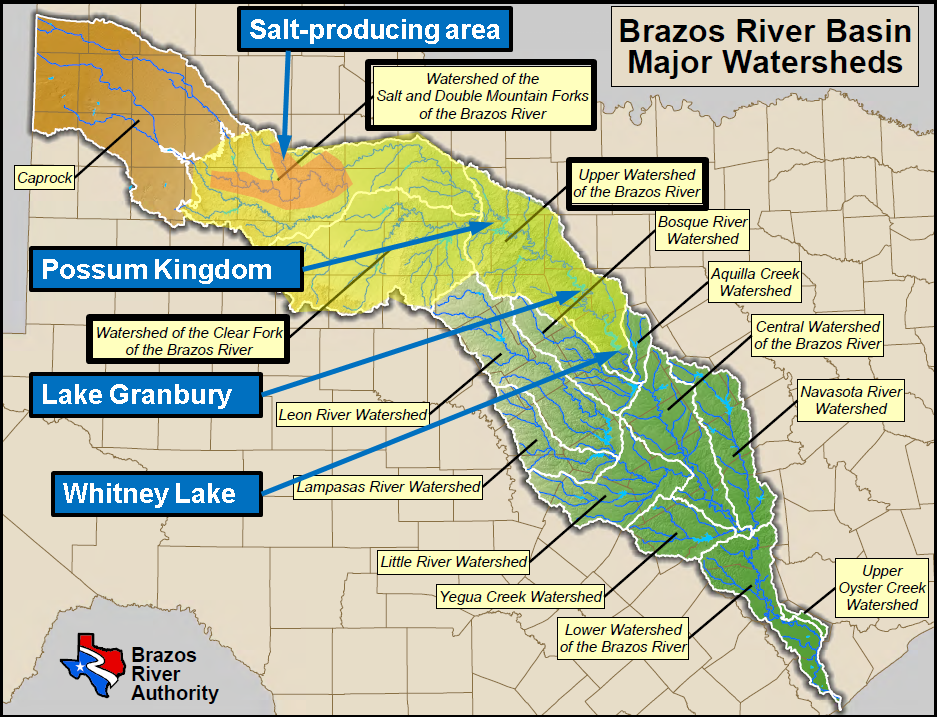
The most common issue affecting water quality and water use in the mainstem of the Brazos River is excessive levels of chlorides and total dissolved solids (TDS). These natural minerals arise from brine springs in the uppermost portion of the Brazos River Basin in Stonewall, Kent and Garza counties that deposit highly mineralized groundwater into the watershed of the Salt Fork and Double Mountain Fork of the Brazos. Rainfall then flushes this residual salt into the river, affecting the mainstem throughout its entire reach. During prolonged droughts chloride and TDS levels in mainstem lakes frequently become even higher than normal. This is caused by evaporation which reduces water levels while leaving chlorides and other minerals in the remaining water.
These elevated mineral concentrations can cause a variety of problems for water users ranging from affecting the capability of the UF/RO systems at industrial and water treatment facilities, causing violations of secondary drinking water regulations at conventional water treatment facilities, having to stop production at industrial facilities, increased maintenance requirements for cooling tower facilities at electrical utilities, and increased permitting and design requirements for electrical utilities.
The purpose of this web page is to predict chloride and TDS levels in Lake Possum Kingdom, Lake Granbury and Lake Whitney considering antecedent conditions in the watershed and/or upstream water bodies. This will allow basin water users to be aware of changing chloride and TDS concentrations and will allow them adjust their operations, if necessary.
Historical water quality data is available at: https://crpdata.brazos.org/